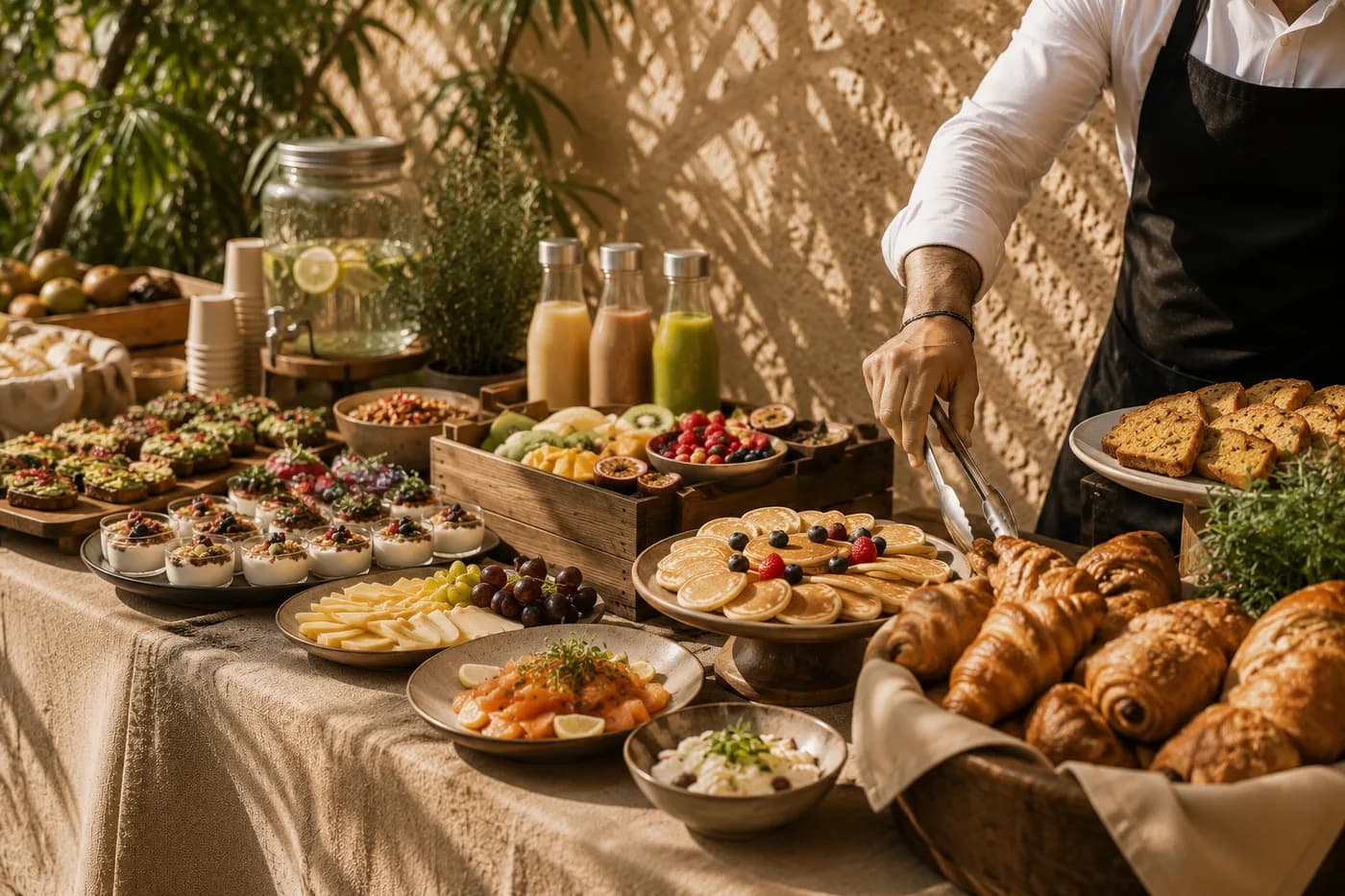
Corporate caterers and CSR: how your choice of supplier fits into your responsible approach
Workplace catering is one of the few CSR items your teams taste every week. Traceability, short supply chains, logistics footprint.
You run a CSR programme and you are looking for actions that are concrete, visible and measurable. The "workplace catering" item is often overlooked in non-financial reports, even though it ticks almost every box: it reaches your employees every week, it is easy to document, and it embodies your commitments in a tangible way. A team breakfast sourced from local artisans says more about your responsible purchasing policy than a paragraph in a charter. Here is how to turn your choice of caterer into a CSR lever you can stand behind.
What a "CSR caterer" really means
A CSR caterer in Paris is first of all a supplier able to answer simple questions: where do your products come from? Who makes them? What are the ingredients? A serious artisan caterer answers these questions by name. An industrial caterer generally cannot: its supply chain goes through central purchasing bodies and own-label brands that make traceability impossible to document.
The CSR criteria that apply to a caterer cover four concrete dimensions: product traceability and quality, supplier proximity (short supply chains), the logistics footprint of delivery, and waste reduction. Each can be the subject of internal reporting and feed into your annual report.
Traceability and ingredients: what to ask
In a CSR approach, food traceability is a natural entry point. Check that your caterer can name its suppliers: an identified artisan bakery, a juice producer with an address, a located market gardener or orchard. L'Écrin Traiteur works with artisans chosen for their transparency:
- Mado Paris madeleines: organic ingredients, palm-oil-free, an identified artisan recipe;
- Alain Milliat juices: whole pressed fruit, zero artificial flavouring, zero concentrate;
- La Ferme de Viltain in Jouy-en-Josas: yoghurts made from the milk of their own herd of 350 cows, sold direct;
- Mariage Frères tea: a sourcing house known for the traceability of its tea gardens.
This list is not a sales argument: it is content you can use directly in your report. To put together a break that illustrates this standard, our breakfasts and breaks rely entirely on this curated selection of artisans.
Short supply chains: when proximity improves the product
A short supply chain is not a communications argument, it is a logistical reality that improves quality. Vergers de Plaisir, orchards planted in 1982 in Plaisir in the Yvelines, supply an artisan apple juice whose freshness comes precisely from not having passed through three warehouses. The bakery D'un Passage à l'Autre in Boulogne-Billancourt bakes its loaf cakes every morning. These are real suppliers in Île-de-France, not concepts.
In a CSR report, these partnerships have documentary value: you can cite producers in Île-de-France, organic certifications, GMO-free and palm-oil-free practices. The same logic applies to our drinks and our fresh fruit formats, consistent with a responsible purchasing policy.
Logistics footprint: local delivery, optimised rounds
Delivery logistics have a real carbon impact. A Paris caterer that delivers within a limited radius, with geographically coherent rounds, has a far smaller footprint than a supplier delivering nationwide from a single hub. L'Écrin Traiteur delivers only in Paris and Île-de-France: no long distance, no national platform. Grouping your orders (combining a breakfast and a lunch tray on the same day, for example) further reduces the number of rounds and therefore the associated footprint.
Reducing waste: the right quantities
Food waste is a CSR indicator often forgotten in workplace catering. The key is getting quantities right: a caterer who advises you on the exact number of pieces per person, depending on the time and context, saves you surplus. For a breakfast, allowing 2 to 3 pieces per person rather than 4 changes both the budget and the volume thrown away. A well-built quote includes this advice from the outset.
Including your caterer in your CSR reporting
For companies that publish a carbon footprint assessment or an annual CSR report, the "workplace catering" item deserves its own section. We can provide the list of our suppliers, their certifications and the information useful for your reporting, whether for a regular ritual of afternoon breaks or a tailor-made reception.
Make your choice of caterer a visible commitment. Request your quote: we reply within 24 hours with a proposal aligned with your CSR requirements, backed by suppliers and certifications.
In 2026, more and more companies are including explicit CSR criteria in their catering tenders, particularly on product origin and waste management.
Frequently asked questions
Can a caterer really feed into a CSR report or a carbon footprint assessment?
Yes, provided it is transparent about its supply chain. On request, we provide the named list of our artisan suppliers, their certifications (organic, palm-oil-free, GMO-free) and the geographical scope of our deliveries: all elements that can go straight into a "catering" section of your CSR report or your non-financial reporting.
Does a short supply chain cost more than an industrial caterer?
The unit price of an artisan product is higher than its industrial equivalent, but the real difference on a team breakfast remains moderate (often €2 to €4 per person). In return, you gain documentable traceability, better quality as perceived by your teams and a concrete CSR argument. A quote calibrated to the right number of pieces also limits waste and therefore the total cost.
How can we reduce the carbon footprint of our catering orders?
Three concrete levers: choose a caterer that delivers locally (Paris and Île-de-France, no national hub), group your orders on the same day to share delivery rounds, and calibrate quantities precisely to avoid surplus being thrown away. We advise you on the right quantities as soon as the quote is drawn up.
An event in Paris or Île-de-France?
Tell us about your event and receive a tailored quote within 24 hours.
Request a quote →