Workplace wellbeing and food: why what your teams eat at the office has become an HR issue
Absenteeism, engagement, employer brand: food at the office is no longer a logistical detail but an HR lever in your workplace wellbeing (QVT) policy.
For years, the question of what teams eat at the office was treated as a logistical problem: hand out meal vouchers, install a vending machine, find a canteen provider. Today, HR directors at companies that attract and keep the best people ask the question differently: is food part of our workplace wellbeing (QVT) policy?
What "Quality of Life and Working Conditions" says about food
QCVT (Qualité des Conditions de Vie et de Travail, quality of living and working conditions), a framework set by the 2013 ANI (national inter-professional agreement) and strengthened by the 2021 Occupational Health Act, explicitly covers employees' eating and break conditions. It is not a detail, it is one strand of the agreement. Companies with a QCVT action plan that has no food component have a documented gap.
In practice, this means that the quality of breaks, the availability of good catering and shared food rituals (team breakfast, monthly afternoon break) can feature in your bilan social (annual social report), your CSR report and your internal survey.
Food as a management signal: what your teams read into your choice of caterer
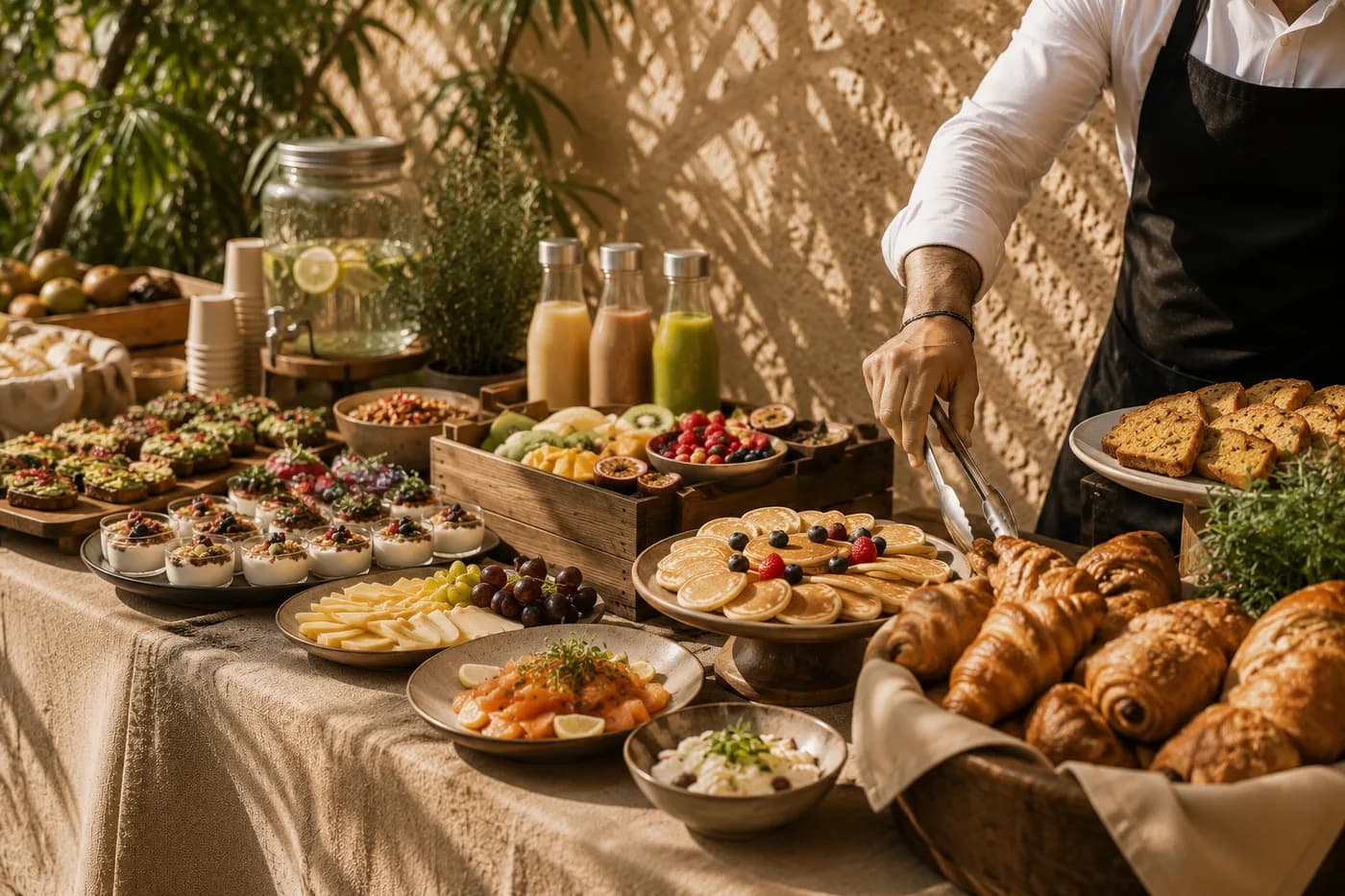
A colleague who is handed industrial pastries in a meeting will not necessarily voice their disappointment. But they will feel it. Conversely, a platter of butter pastries, Mado Paris madeleines whose brand they recognise, an artisan juice that tastes of something: that is a subliminal but real signal, we thought of you, this moment matters.
This signal is particularly strong for two profiles: new hires (who build their image of the company in their first weeks) and senior staff (who have the references to judge the effort made). In both cases, food contributes to how the company culture is perceived.
Absenteeism, staff turnover and food: an indirect but documented link
A study by Sodexo (2019) of 1,000 French employees showed that 87% of respondents felt that the quality of workplace catering had an impact on their quality of life at work. A meta-analysis published in the Journal of Occupational and Environmental Medicine establishes a link between good nutrition and a reduction in short-term absenteeism (days of sick leave).
These figures do not prove that a platter of artisan croissants reduces staff turnover, but they confirm that food is not neutral in the engagement equation. Companies that take the subject seriously have built it into their thinking: it is an investment, not an expense.
How to build food into your QCVT policy in practice
Three levels of action, depending on your budget and your ambition:
- Level 1, Regular shared ritual: a monthly team breakfast or a weekly afternoon break. Modest budget, strong impact on team spirit. The ideal format to start with.
- Level 2, Consistent quality: replace the industrial products at meetings with an identified artisan selection, from the midday lunch tray to the afternoon breaks. Talk about the artisans you have chosen in your internal communications.
- Level 3, Inclusion in QCVT reporting: document your food choices in your bilan social or CSR report. Name your suppliers, cite their certifications (organic, palm-oil-free, short supply chain).
L'Écrin Traiteur as a QCVT partner
L'Écrin Traiteur works with identified, documented artisans: Mado Paris artisan madeleines, Alain Milliat juices (whole fruit, no concentrate), La Ferme de Viltain yoghurts (direct supply chain, Jouy-en-Josas). We can provide the list of our suppliers, their certifications and the information needed for your QCVT reporting. Discover our full corporate catering offer, or contact us at commercial@lecrin-traiteur.fr.
Make food a concrete pillar of your QCVT policy
Building food into your workplace wellbeing approach requires neither a canteen nor an outsized budget: a regular ritual, consistent quality and suppliers you can document are enough to turn a logistical item into a measurable HR lever. From the morning break to the midday lunch tray, by way of internal receptions, we adapt each format to your team and your reporting. Delivery from 6:30 am in Paris and Île-de-France, reply within 24 hours: request your quote and let us structure the food component of your QCVT policy together.
Frequently asked questions
Is food part of QCVT?
Yes. QCVT (Qualité des Conditions de Vie et de Travail, quality of living and working conditions), set by the 2013 ANI and strengthened by the 2021 Occupational Health Act, covers employees' eating and break conditions. Companies with a QCVT action plan can document their food choices in their bilan social (annual social report) or CSR report.
Can you mention your caterer in a CSR report or QCVT review?
Yes. Naming your artisan suppliers, their certifications (organic, palm-oil-free, short supply chain) and your approach to good food is relevant content for your CSR report or your internal QCVT survey.
What budget should you plan for the food component of a QCVT policy?
A monthly shared food ritual (artisan team breakfast or afternoon break) costs between €8 and €16 per person excl. VAT depending on the format (Classique option from €8, full breakfast from €12 to €16). For a team of 20 people, allow €160 to €320 per month excluding delivery, a budget lower than most HR team-building initiatives.
An event in Paris or Île-de-France?
Tell us about your event and receive a tailored quote within 24 hours.
Request a quote →