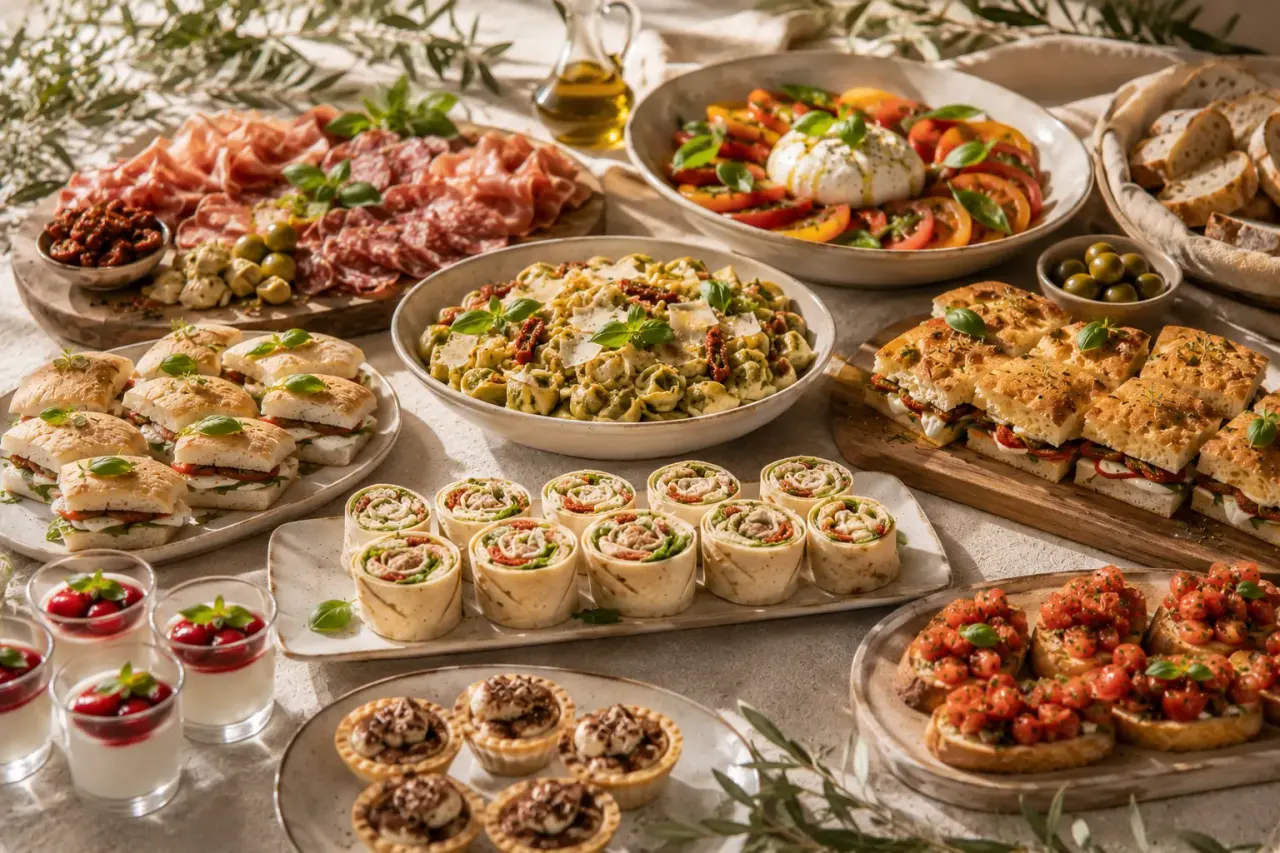
Setting up a corporate buffet: serving utensils, equipment and a smooth layout
A buffet that goes wrong rarely comes down to the recipes, but to the set-up. Serving utensils, dish layout, serving points: our layout guidelines.
A buffet that goes wrong is almost never about the recipes. It is a set-up problem: badly arranged dishes, not enough serving utensils, a single queue that holds everyone up. Here is how to organise the layout of your corporate buffet so that it holds up for the whole meal, without spending hours on it.
Why the set-up changes everything
Even the best menu loses its effect if the table is poorly thought out: dishes emptying on one side while the other stays full, a queue forming for lack of a second serving point, serving utensils nowhere to be found. The set-up is not an aesthetic detail, it is what determines whether the buffet runs without a hitch.
The serving utensils to plan
Each dish needs its own serving utensil, so that the contents of one dish do not mix with another — a real issue when some guests follow a particular diet. Plan one pair of tongs or one spoon per savoury dish, a cake server or pastry tongs for the desserts, and a separate sauce spoon if a dish comes with one. Plan generously: one missing serving utensil means a queue forms.
Plates, cutlery, napkins: to provide in-house or to order
Tableware is not always included in a catering quote. Specify when ordering if you need plates, cutlery and napkins: allow €3 to €8 per person extra depending on the format. If your office already has reusable tableware, that is money saved, and more responsible.
How to arrange the dishes on the table
Order matters. Place salads and cold dishes first in the direction people move, then the more substantial dishes, and finish with the desserts, at a distance from the savoury food to avoid mixing. Drinks are ideally set out on a separate table: it keeps people moving and avoids a bottleneck around the main buffet.
How many serving points for your headcount
Beyond 20 to 25 guests, a single serving point creates a queue that eats into the break. Split the table (or duplicate the main dishes at each end) above this threshold, so that everyone is served within the first ten minutes.
Who sets up the buffet on the day?
At L'Écrin Traiteur, sharing menus and canapé platters arrive already laid out, ready to put on the table: no extra staff needed for the set-up. All you need to provide is the space and, if needed, the tableware.
Order a buffet already laid out in Paris
No more set-up headaches: our sharing menus and canapé platters are delivered ready to serve, in Paris and Île-de-France. Request your quote, we take care of the rest.
Frequently asked questions
How many serving utensils should I plan for a corporate buffet?
Plan one dedicated serving utensil per dish (tongs or a spoon), to avoid dishes mixing and to keep the service flowing. Better one utensil too many than a queue forming for lack of one.
In what order should dishes be arranged on a buffet?
Place salads and cold dishes first in the direction people move, then the more substantial dishes, and finish with the desserts at a distance from the savoury food. Drinks are ideally set out on a separate table.
From how many guests do you need two serving points?
Beyond 20 to 25 guests, a single serving point creates a queue. Splitting the table or duplicating the main dishes means everyone can be served quickly.
Does the buffet arrive already laid out or does it need setting up?
At L'Écrin Traiteur, sharing menus and canapé platters arrive already laid out, ready to put on the table. All you need to provide is the space and, if needed, the tableware.
An event in Paris or Île-de-France?
Tell us about your event and receive a tailored quote within 24 hours.
Request a quote →